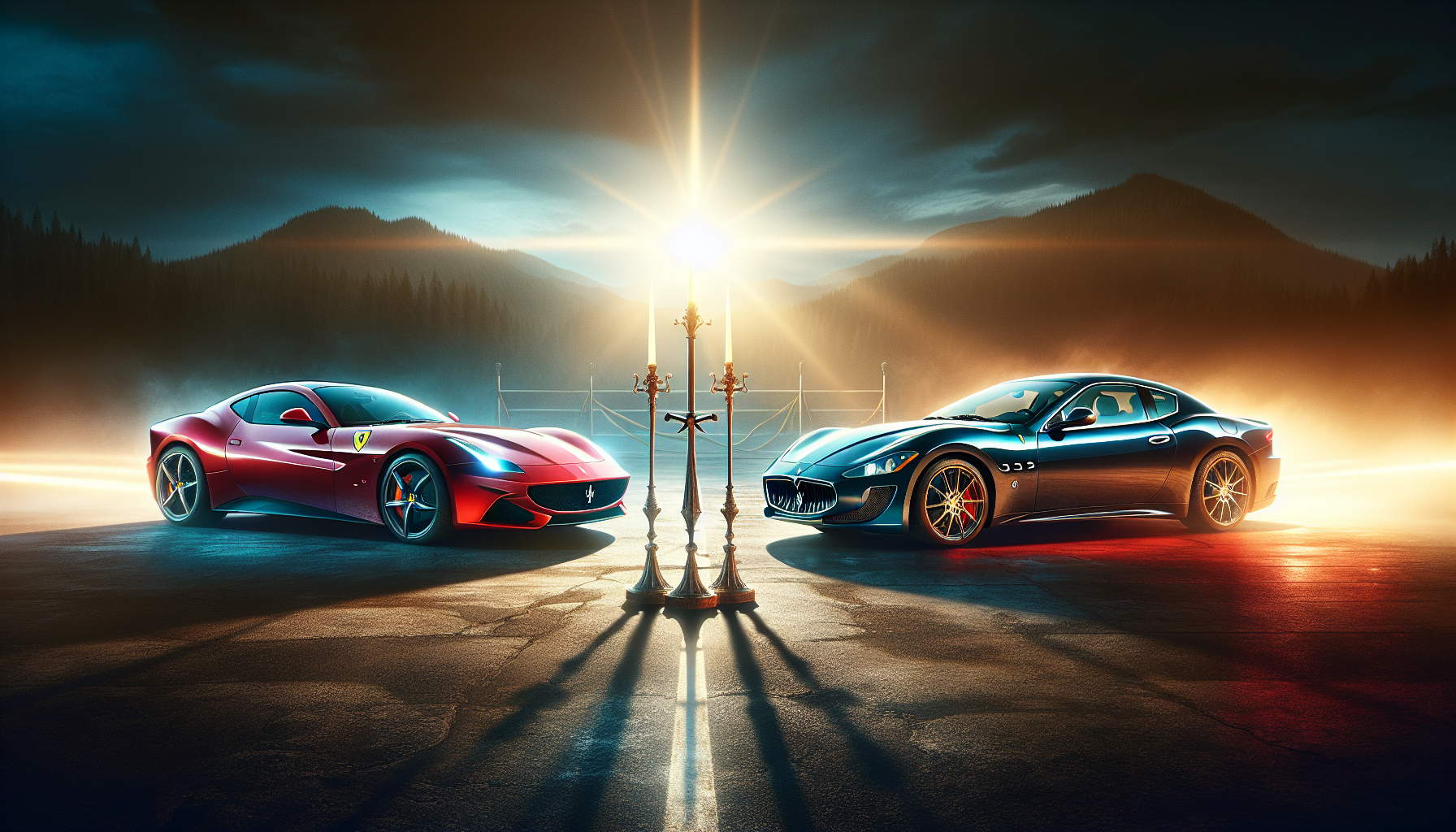
Ferrari Roma vs Maserati GranTurismo: Grand Touring Italian Style
There's a particular kind of road trip that demands a particular kind of car. Not a track-focused supercar that punishes your spine on every imperfection, and not a luxury sedan that insulates you so thoroughly from the experience that you might as well be on a train. Grand tourers occupy a very specific and very satisfying middle ground — machines built to cover ground quickly, comfortably, and with enough theatrical drama to make the journey the point. When the subject turns to Ferrari Roma vs Maserati GranTurismo: Grand Touring Italian Style, you're talking about two of the most culturally significant GT cars on the market today, each carrying the weight of Italian automotive history on its beautifully sculpted shoulders.
The Ferrari Roma arrived in 2020 as a deliberate statement of restraint from Maranello. Where earlier Ferraris leaned into aggression, the Roma seduced with understatement — clean lines, a long hood, and an interior that felt more like a boutique lounge than a race car cockpit. The Maserati GranTurismo, in its newest form, returned in 2023 after years of anticipation with a completely reengineered platform and the option of a Nettuno twin-turbo V6 or, remarkably, a fully electric powertrain called the Folgore. Two different philosophies, two different price points, and two very different answers to the question of what a modern Italian GT should be.
Choosing between them isn't straightforward, and that's precisely why the comparison is worth making seriously. Both cars have genuine strengths and real compromises. The Roma trades on exclusivity and raw driver engagement; the GranTurismo counters with broader accessibility, a more usable cabin, and the kind of brand heritage that makes it recognizable even to people who've never been near a racetrack. This article works through both cars methodically — performance, design, practicality, and value — before arriving at a clear recommendation.
Ferrari Roma
The Roma is arguably the most beautiful Ferrari produced in the last two decades. Pininfarina's influence runs through every surface, and the result is a car that looks expensive without looking fussy. The 3.9-liter twin-turbocharged V8 produces 612 horsepower and 561 lb-ft of torque, routed through an eight-speed dual-clutch gearbox to the rear wheels. Ferrari quotes a 0-62 mph time of 3.4 seconds and a top speed of 199 mph. These are not just impressive numbers in isolation — they represent a level of performance that remains genuinely difficult to replicate at any price point.
The driving experience is defined by communication. Ferrari's magnetorheological dampers read the road surface and adjust within milliseconds, and the steering is sharp enough that you're always aware of what the front tires are doing. The Roma isn't as raw as the 488 or F8 Tributo it effectively replaced in the lineup for some buyers, but it replaces that rawness with something more nuanced — a car that rewards patience and precision rather than just bravado. The Side Slip Control system has been refined to allow controlled oversteer at the track while keeping things predictable on the road.
Inside, the Roma uses Ferrari's latest generation cockpit with dual curved screens framing the driver. Material quality is exceptional, and the optional Tailor Made personalization program means that no two Romas need look the same. The rear seats are present but genuinely compromised — adults will not be comfortable back there for any meaningful distance. Cargo space behind those seats amounts to roughly 270 liters with the rear seats folded, which is workable for weekend luggage but not generous.
Pricing starts around $222,000 in the United States before options, and options on a Ferrari are never inexpensive. A well-specified Roma with the Tailor Made program and preferred options can push well past $280,000. This is a car that knows exactly what it is and makes no apology for the cost of admission.
| Pros | Cons |
|---|---|
| One of the most beautiful cars produced in its era | Rear seats are essentially unusable for adults |
| 612 hp twin-turbo V8 delivers thrilling performance | Starting price over $222,000 before options |
| Exceptional steering feedback and driver engagement | No all-wheel drive option — challenging in adverse weather |
| World-class interior materials and craftsmanship | Options and personalization add cost rapidly |
| Strong resale value typical of Ferrari product | Boot space is modest for a grand tourer |
| Refined suspension without sacrificing sportiness | Tight dealer allocation makes purchase process competitive |
Maserati GranTurismo
Maserati relaunched the GranTurismo in 2023 with a genuinely ambitious brief: offer buyers a true 2+2 GT in a choice of combustion or fully electric guise, at a price that undercuts the obvious Ferrari and Bentley competition by a meaningful margin. The combustion version, called the Trofeo, uses Maserati's Nettuno V6 — a twin-turbocharged engine with a pre-chamber ignition system derived from Formula 1 principles — producing 542 horsepower and 538 lb-ft of torque. The Folgore variant uses a three-motor electric setup producing around 761 horsepower.
The GranTurismo's proportions are more traditional than the Roma's — a longer wheelbase, a more upright greenhouse, and genuinely usable rear seats that will accommodate adults for journeys of moderate length. This distinction matters more than it might seem on paper. A true grand tourer has always been defined partly by its ability to carry passengers in reasonable comfort, and the Maserati delivers on that promise in a way the Ferrari doesn't quite manage.
On the road, the GranTurismo Trofeo is fast and engaging without being demanding. The Nettuno engine sounds extraordinary at high revs, with a mechanical intensity that belies its displacement. The chassis is resolved and balanced, though it doesn't communicate with quite the intimacy of the Ferrari. The electric Folgore is in some ways the more interesting proposition for pure street driving — the instant torque delivery makes it devastating in a straight line, and the 800-volt architecture enables rapid charging. Maserati claims 0-62 mph in 2.7 seconds for the Folgore, which would make it measurably quicker off the line than the Roma.
Interior quality has improved dramatically over the previous generation. The cabin uses real leather, open-pore wood, and machined aluminum, and the layout is more traditional than the Roma's digital-forward approach. Some might find the GranTurismo's cockpit slightly less dramatic, but it is also less demanding — everything is logically placed, and the overall ambiance is genuinely luxurious rather than sport-focused.
Pricing for the GranTurismo Trofeo begins around $185,000 in the United States, with the Folgore priced comparably. This represents a meaningful saving over the Roma before a single option is selected, and Maserati's option pricing tends to be less aggressive than Ferrari's.
| Pros | Cons |
|---|---|
| Genuinely usable rear seats for adults | Brand prestige doesn't match Ferrari's market position |
| Nettuno V6 sounds and performs brilliantly | Resale value has historically been weaker than Ferrari |
| Folgore EV variant offers 761 hp and 2.7-second 0-60 | Maserati reliability reputation remains mixed |
| More accessible price point than the Roma | Less driver feedback and intimacy than the Ferrari |
| Broader powertrain choice including full electric | Interior design is good but less dramatic than Roma |
| More practical cargo area and everyday usability | Nettuno engine warranty and service costs bear research |
Design and Character
This is where the two cars differ most profoundly, and where personal values will determine much of the decision. The Roma's design philosophy is about controlled tension — surfaces that appear smooth and almost effortless but reveal their complexity as the light moves across them. The Fiorano Yellow or Grigio Ingrid color options make the Roma look like it belongs in a 1960s Italian film, and that's not accidental. Ferrari's design team under Flavio Manzoni was explicit about the Roma's cinematic references, invoking the Dolce Vita spirit of the 1950s and '60s Ferraris.
The new GranTurismo takes a different approach, one that references its predecessor more directly. The long hood and curvaceous flanks are recognizable from the original GranTurismo that ran from 2007 to 2021, which itself became a minor classic. The new car is wider, lower, and more muscular than its predecessor, but it retains the same fundamental shape language. Where the Roma feels like it's been distilled to its essence, the GranTurismo feels like it has been matured and refined.
Neither approach is wrong. They simply appeal to different temperaments. The Roma is the choice of someone who finds restraint and precision genuinely attractive. The GranTurismo is for someone who wants presence, a car that announces itself with confidence rather than quiet self-assurance.
Performance and Driving Dynamics
On raw numbers, the Ferrari Roma vs Maserati GranTurismo: Grand Touring Italian Style comparison produces interesting results. The Roma's 3.4-second 0-62 sprint is impressive, but the GranTurismo Folgore's claimed 2.7 seconds is faster. The Roma's top speed of 199 mph edges out the Trofeo's 196 mph. Neither number will ever be relevant on a public road, but they indicate the performance ceiling of each car.
More meaningful is how each car behaves at road speeds. Ferrari's decades of experience with rear-wheel-drive performance cars shows in the Roma's handling precision. The car responds to inputs with a directness that remains remarkable — turn-in is immediate, and mid-corner adjustability is excellent. Ferrari's engineering culture prizes the relationship between driver and machine above almost everything else, and that ethos permeates the Roma's chassis tuning.
The GranTurismo is not far behind in terms of dynamic capability, and on real roads the difference will be smaller than track testing might suggest. The longer wheelbase contributes to high-speed stability and ride quality, both of which matter considerably on a transatlantic drive or an Alpine crossing. The Maserati chassis engineering team, working under former Ferrari engineers, produced a car that is resolved and confidence-inspiring without being artificially softened.
The Folgore's electric powertrain introduces a completely different dynamic character. Torque vectoring through three independent motors gives it poise in corners that the combustion version can't match, and the absence of a traditional powertrain means the Folgore can do things that the Roma simply cannot.
Practicality and Everyday Usability
Grand touring implies, by definition, that the car needs to be useful over long distances. A Ferrari Roma vs Maserati GranTurismo: Grand Touring Italian Style assessment that ignored practicality would be incomplete. This is the area where the GranTurismo makes its strongest argument.
The rear seats in the GranTurismo are a genuine asset. Two adults of average height can manage a two-to-three hour journey in the back without significant complaint — this opens the car to use cases that the Roma simply cannot address. School runs, airport trips with a family member, longer journeys with friends: all of these are plausible in the Maserati and implausible in the Ferrari.
Boot space in the GranTurismo is larger, and the car's overall dimensions mean that it's proportioned more like a traditional 2+2 GT and less like a sports car with token rear accommodation. The Roma is absolutely usable as a daily driver, but it is primarily a driver's car that tolerates passengers, whereas the GranTurismo is a passenger car that also happens to be genuinely exciting to drive.
Fuel consumption, insurance costs, and service intervals all factor into ownership calculations. Ferrari's service network is excellent but not cheap, and the Roma will require maintenance at intervals and costs that reflect its engineering complexity. Maserati's service costs are generally lower, though the brand's historical reliability record has been patchy enough that extended warranty coverage deserves serious consideration.
Value and Ownership Experience
Ferrari ownership carries intangible benefits that are difficult to quantify but genuinely real. The Roma's exclusivity, its waiting list at most dealers, and the broader Ferrari community all add to the experience of ownership in ways that pure specification comparison can't capture. Ferrari cars have historically held their value extremely well — in some cases appreciating significantly — which changes the calculus of what the car actually costs over a five-year ownership period.
Maserati's value proposition is more straightforward. You get a great deal of car for the money, and the lower purchase price means that resale depreciation, while proportionally similar, represents a smaller absolute loss. The GranTurismo also benefits from Maserati's broader dealer network and a slightly more approachable ownership culture.
For buyers who want the maximum return on investment and the most prestigious badge, Ferrari wins comfortably. For buyers who want the most usable, versatile, and comparatively affordable Italian GT experience, the Maserati makes a compelling case.
Verdict
In the comparison of Ferrari Roma vs Maserati GranTurismo: Grand Touring Italian Style, the Ferrari Roma is the better car by the measures that matter most to the buyer this comparison is really about.
This isn't a dismissal of the Maserati — the GranTurismo is a genuinely excellent car and the most convincing Maserati has produced in years. The Folgore variant in particular represents a technically ambitious and emotionally satisfying interpretation of the GT formula. For buyers who need rear-seat utility, who want a lower entry price, or who are genuinely interested in the electric powertrain option, the GranTurismo is the right recommendation.
But the Roma is in a different class as a driver's machine, as a design object, and as a long-term investment. The driving experience — the specificity of the steering, the brutality of the V8's upper register, the way the car communicates its limits clearly and consistently — is something that Ferrari has refined over decades and that remains difficult to replicate. The design will age gracefully in a way that few modern cars manage. And the Ferrari badge, for better or worse, carries a weight of cultural significance that translates directly into market value.
If you're deciding between these two cars and the price difference is not a decisive factor in your budget, choose the Roma. You will not wonder what you're missing. If the extra $35,000 to $50,000 matters, or if you regularly need to carry adults in the rear seats, or if the electric powertrain option genuinely appeals to your driving life, the GranTurismo will reward your choice without compromise. Either way, you're buying into the finest tradition of Italian grand touring — a tradition that both Maranello and Modena have every reason to defend.
FAQ (Frequently Asked Questions)
Is the Ferrari Roma faster than the Maserati GranTurismo?
In combustion form, the Roma and GranTurismo Trofeo are closely matched, with the Roma's 612 hp edging out the Trofeo's 542 hp. However, the GranTurismo Folgore's three-motor electric setup produces around 761 hp and is claimed to reach 62 mph in 2.7 seconds, compared to the Roma's 3.4 seconds. Top speed goes to the Roma at 199 mph versus the Trofeo's 196 mph, though neither figure is practically relevant on public roads.
Which car is more practical for everyday use?
The GranTurismo is meaningfully more practical. Its rear seats can accommodate adults for moderate journeys, it has more cargo space, and its overall dimensions make it more versatile as a daily driver. The Roma has nominal rear seats but they are genuinely unsuitable for adult passengers on any trip of length. If practicality matters to your ownership plan, the Maserati is the clear choice.
How do the two cars compare in terms of long-term value retention?
Ferrari has a well-established track record of strong resale values, and the Roma is no exception — low production volumes and high demand mean that well-specified examples hold value effectively. Maserati's historical depreciation has been steeper, though the new GranTurismo's reception has been more positive than previous generations. For buyers who consider resale value part of the total cost of ownership, the Ferrari holds a significant advantage.
What makes the Maserati GranTurismo Folgore different from a conventional GT car?
The Folgore uses a three-motor electric drivetrain with an 800-volt architecture, producing around 761 horsepower. Its torque vectoring capability means that each rear motor can be controlled independently, giving it cornering dynamics unavailable to conventional rear-wheel-drive GTs. The 800-volt charging architecture also enables faster charging than most electric vehicles. It represents a genuinely different kind of GT experience while maintaining the traditional proportions and cabin quality of the combustion GranTurismo.
Which car is better suited to long-distance grand touring specifically?
Both cars are capable of long-distance touring, but the GranTurismo's longer wheelbase, more accommodating rear seats, and generally smoother ride quality make it the more natural choice for the classic GT scenario — covering hundreds of miles in a day with passengers in relative comfort. The Roma is better suited to a driver-focused interpretation of grand touring: fast, engaging, and supremely rewarding, but primarily focused on the driver rather than the journey shared with passengers.