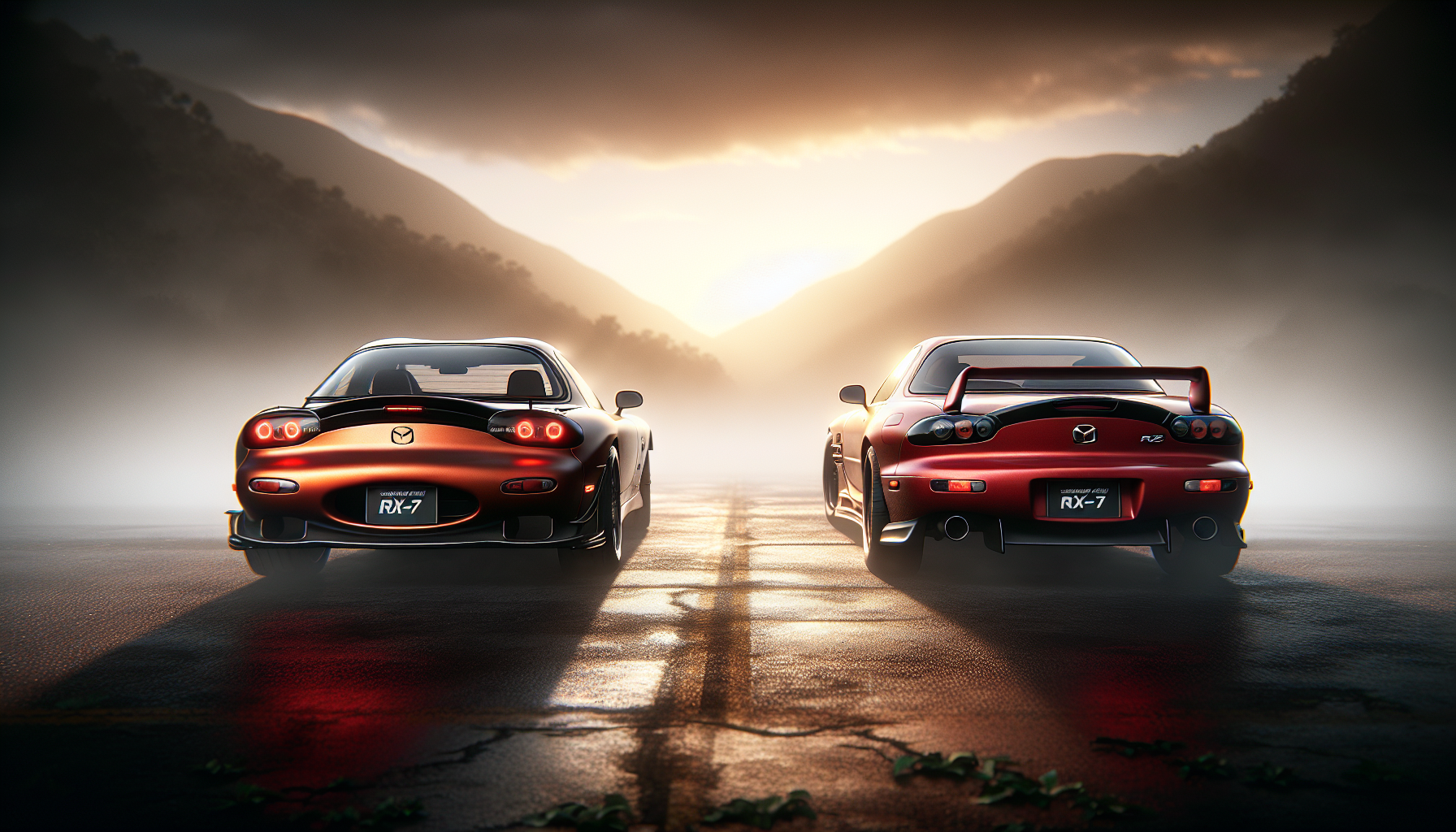
Mazda RX-7 vs RX-8: Rotary Engine Showdown
Few rivalries in the sports car world are as philosophically charged as the one between the Mazda RX-7 and RX-8. These two machines represent entirely different interpretations of what a rotary-powered sports car should be — one an uncompromising, twin-turbocharged missile built to dominate corners and drag strips alike, the other a more accessible, daily-friendly coupe that tried to win hearts through practicality and balance. The debate has been going on for two decades, and anyone who's owned both will tell you it's more nuanced than the internet comment sections suggest.
The backbone of this comparison is, of course, the Wankel rotary engine. As noted on Wikipedia's Mazda RX-7 page, Mazda had been perfecting rotary engine-powered products long before either the RX-7 or RX-8 arrived, starting with the Cosmo and Luce luxury models. That long engineering lineage meant that by the time the third-generation RX-7 landed in 1992, Mazda had effectively built one of the most exotic powerplants available in a mass-production car. When the RX-8 replaced it in 2003, Mazda took that same philosophy and bent it toward a different set of priorities. As CarThrottle points out, the RX-8 was a front-engined, rear-wheel drive sports car powered by a rotary engine, just like its forerunner — but it took things in a slightly different direction.
This article pits these two icons against each other across the metrics that actually matter: performance, everyday usability, reliability, tuning potential, and long-term ownership experience. Whether you're in the market for a weekend warrior, a track day weapon, or a future classic, the Mazda RX-7 vs RX-8: Rotary Engine Showdown deserves a thorough, honest breakdown. Let's get into it.
The Mazda RX-7: A Performance Icon Built Around the Wankel
The RX-7 ran from 1978 to 2002 across three generations, and each one earned its reputation on its own merits. According to DRIFTED's comprehensive RX-7 vs RX-8 comparison, all models featured rotary engines throughout the entire production run — a commitment that few manufacturers would have sustained given the engineering challenges involved. The first generation drew design inspiration from the Lotus Elan, featuring that now-iconic long sloping hood and pop-up headlights. The second generation refined the formula. The third generation, known as the FD3S or Series 8 in Japan, turned it into something extraordinary.
That final RX-7 is the car most people mean when they say "RX-7." The FD3S came equipped with a twin-turbocharged 13B-REW rotary engine producing 255 horsepower in international markets, though the Japanese-spec car was officially rated at 280 hp under the gentleman's agreement of the era. CarBuzz reports that the RX-7 Series 8 boasts well over 200 horsepower per liter from its Wankel rotary engine — a specific output figure that humbled far more expensive machinery at the time. The entire car weighed just over 1,200 kilograms in base trim, which meant the power-to-weight ratio was genuinely supercar-adjacent for a mid-1990s production vehicle.
The driving experience is visceral. The sequential twin-turbo system creates a surge of power delivery that's difficult to replicate with conventional engines, and the low center of gravity from the compact rotary unit sitting behind the front axle gives the car a mid-engined feel despite its front-engine layout. Steering is sharp, the chassis is neutral, and at the limit, the FD3S is one of the most rewarding cars ever built by any manufacturer, at any price. However, all of that comes with real-world caveats: reliability concerns around apex seals, poor fuel economy, a small cabin, and the constant financial demand of proper maintenance make it a car you need to be committed to before signing any paperwork.
| Pros | Cons |
|---|---|
| Exceptional power-to-weight ratio | Apex seal failures are expensive and common if neglected |
| Sequential twin-turbo 13B-REW delivers extraordinary performance | Poor fuel economy (often single-digit MPG under hard driving) |
| Legendary driving dynamics and chassis balance | Very tight two-seater cabin — no practical daily use |
| Massive tuning and aftermarket support | High coolant and oil consumption from the factory |
| Strong cultural cachet and collectible status | Increasingly rare and expensive to purchase in good condition |
| Featherweight construction aids handling in all conditions | Catalytic converter and emissions equipment can cause heat-related issues |
| Proven motorsport heritage across GT, circuit, and drift disciplines | Parts availability tightening as the car ages |
The Mazda RX-8: The Misunderstood Successor
The RX-8 arrived for the 2003 model year and immediately drew comparisons to its predecessor — comparisons it almost always lost in the court of public opinion, despite being a genuinely accomplished machine. As TopSpeed explains, the RX-8 is missing the forced induction of the RX-7, which is one of the central reasons it never grabbed enthusiasts in the same way. Without a turbocharger, the naturally aspirated RENESIS engine producing 232 horsepower in high-compression trim couldn't match the dramatic power delivery of the outgoing twin-turbo car. On paper, it looked like a step backward.
But the RX-8 was never really trying to be a faster RX-7. According to Wikipedia's entry on the Mazda Wankel engine, the RENESIS engine — designated the 13B-MSP (Multi-Side Port) — was specifically designed to reduce exhaust emissions and improve fuel efficiency compared to earlier 13B variants. It was an engineering achievement in its own right, moving the exhaust ports to the side of the rotor housing rather than the peripheral position used previously. This allowed for cleaner combustion and better emissions compliance, critical requirements for any production car entering the 2000s market.
What the RX-8 gained was balance and usability. It featured a genuinely revolutionary door configuration — rear-hinged "freestyle" doors that revealed a proper back seat capable of carrying two adult passengers. The chassis was wider and longer than the RX-7, improving stability and making the car feel more planted at high speeds. As noted on the Mazda RX-8 Wikipedia page, the car is widely considered the successor to the RX-7 as Mazda's rotary engine sports car, even if it was underpowered in comparison to the final RX-7 variant. The RX-8 was also slightly easier to maintain in daily use — though "easier" is a relative term when you're talking about any naturally aspirated rotary that demands regular warm-ups and proper cool-down procedures.
The RX-8's weaknesses are well documented. Low-speed oil burning, flooded engines when shut off before reaching operating temperature, and the same apex seal vulnerability that haunts all rotary owners. The naturally aspirated setup also means the car doesn't lend itself to simple, dramatic power gains the way the RX-7 does. Slapping a turbo kit on an RX-8 is possible but complex, and many would argue you're better off starting with the RX-7 if forced induction is what you want.
| Pros | Cons |
|---|---|
| Practical 2+2 seating with freestyle rear doors | Naturally aspirated — significantly less dramatic performance than the RX-7 |
| Wider, more stable chassis with excellent balance | Prone to engine flooding if shut off cold or before reaching operating temperature |
| RENESIS engine is smoother and cleaner than earlier 13B variants | Lower resale value compared to the FD3S RX-7 |
| Lower purchase price makes it an accessible entry into rotary ownership | High oil consumption required by design — not a fault, but a reality |
| More forgiving handling for less experienced drivers | Turbocharging requires significant modification work |
| Comfortable enough for daily driving | Emissions certification became difficult in some markets, limiting used supply |
| Good parts availability given more recent production run (2003–2012) | Less cultural prestige — often unfairly dismissed as "the lesser rotary" |
Performance Numbers: What the Specs Actually Say
Comparing raw numbers between the RX-7 and RX-8 tells part of the story. The FD3S RX-7 in standard international trim produces 255 horsepower and 294 Nm of torque at a weight of roughly 1,260 kg, giving a power-to-weight ratio in the vicinity of 202 hp per tonne. The RX-8 in its highest-output 232 hp configuration weighs approximately 1,310 kg, landing at about 177 hp per tonne. That gap is meaningful on a track, particularly given the RX-7's sequential turbo system and its ability to deliver power in a more aggressive, linear-to-surge fashion.
OctoClassic's comparison of the two cars observes that the RX-8 might not deliver the same level of nimbleness as the RX-7, especially in tight corners and aggressive driving scenarios. That assessment aligns with most experienced driver reports: the RX-7 is a sharper, more aggressive instrument, while the RX-8 is more forgiving and composed. Both handle well by any objective standard, but the RX-7's lighter weight and more aggressive tune give it a definitive edge when the road gets technical.
Where the RX-8 partially makes up ground is in real-world driveability. The power delivery is smoother and more predictable, which makes it faster in the hands of average drivers who might struggle with the RX-7's turbo surge and lighter rear end. On a mountain road in wet conditions, a skilled but not expert driver might actually be quicker in the RX-8 simply because confidence margins are wider.
Ownership Costs and Long-Term Reliability
Neither car is cheap to own. Let's be direct about that. Both require an owner who understands rotary engines, respects warm-up procedures, uses the correct oil weight, and isn't alarmed by fuel consumption figures that would embarrass a Dodge Challenger.
The RX-7 demands more financially. Good FD3S examples now command significant sums — a clean, unmodified low-mileage car can fetch anywhere between $25,000 and $60,000 depending on specification and condition. Engine rebuilds, when required, are labor-intensive and expensive. The apex seals in a neglected or improperly run 13B-REW will fail, and at that point you're looking at a full rebuild or a replacement engine sourced from Japan.
The RX-8 is cheaper to enter but not dramatically cheaper to maintain. Engines can flood — a known issue that Mazda issued specific guidance on — and replacement engines are more readily available and less costly than their RX-7 counterparts. However, the RX-8 has suffered in perception, leading many owners to underinvest in maintenance, which creates a secondhand market full of neglected examples that require significant remediation work before being trusted on a daily drive.
For anyone approaching the Mazda RX-7 vs RX-8: Rotary Engine Showdown from a pure investment standpoint, the RX-7 is already a proven appreciating asset. CarBuzz has reported on the RX-8 as a future classic, noting that with the Mazda Iconic SP concept previewing a twin-rotor range-extender hybrid powertrain, interest in the car's heritage has been growing. But the gap in appreciation trajectory between the two is wide, and experienced collectors will always pay more for the FD3S.
Tuning and Motorsport Potential
The RX-7 wins this category decisively. The 13B-REW engine responds well to modifications — upgraded turbos, porting work, standalone ECU mapping, and suspension tuning can transform an already fast car into something that competes with modern sports cars costing five times as much. The platform's motorsport pedigree across drift competitions, time attack, and endurance racing provides an enormous knowledge base and parts ecosystem for anyone who wants to build seriously.
The RX-8 is tunable, but the ceiling is lower without forced induction, and adding it significantly complicates the build. Port timing, intake modifications, and suspension work are worthwhile, but the starting point is less dramatic, and the gains come harder.
Verdict
In the Mazda RX-7 vs RX-8: Rotary Engine Showdown, the RX-7 wins. It's not a close call for anyone whose priority is performance, driver engagement, tuning potential, or long-term investment value. The FD3S is one of the greatest sports cars ever produced, full stop. Its power-to-weight ratio, chassis dynamics, and sheer mechanical drama put it in a category the RX-8 simply cannot reach. Mazda's own executives have acknowledged the desire to bring back something in the spirit of the RX-7, which tells you everything about how the two cars sit in the brand's own hierarchy.
That said, the RX-8 is not a bad car — it's a misunderstood one. If you want a rotary experience with four usable seats, a more forgiving driving character, and a lower barrier to entry, the RX-8 is a legitimate choice. It deserves more respect than it typically gets. For daily transport that happens to come with a howling rotary soundtrack and rear-wheel drive, it's genuinely good.
But if you have to choose one, make it the RX-7. Just commit to maintaining it properly, budget for engine work, and accept that you're buying a car that requires partnership. For those willing to make that deal, few machines on the road — at any price — offer anything quite like it.
FAQ (Frequently Asked Questions)
Is the Mazda RX-7 reliable enough for daily driving?
It can be, but it demands more attention than a conventional car. The 13B-REW rotary engine requires proper warm-up before hard driving, correct oil specification, and regular coolant checks. Neglect leads to apex seal failure, which is expensive to repair. Many owners use the RX-7 as a weekend or track car precisely to avoid the stress of daily rotary ownership. If you're committed to the maintenance schedule and understand rotary engine behavior, daily use is possible — but it's not forgiving of shortcuts.
Why doesn't the RX-8 have a turbocharger like the RX-7?
Mazda made a deliberate engineering choice with the RENESIS engine to prioritize emissions compliance and cleaner combustion over outright performance. As documented on the Mazda Wankel engine Wikipedia page, the 13B-MSP moved exhaust ports to the side of the rotor housing to reduce emissions — a design that made forced induction more technically complex to integrate. The RX-8 was also positioned as a more practical, accessible sports car rather than a pure performance machine, and a naturally aspirated setup aligned better with that mission.
Which is better for track use — the RX-7 or the RX-8?
For track use, the RX-7 is the stronger choice in the hands of an experienced driver. Its lighter weight, sharper chassis response, and dramatic turbocharged power delivery give it a significant edge when pushing close to the limit. The RX-8's wider, more stable platform can actually work in favor of newer track drivers who benefit from a more forgiving car, but at the sharp end of amateur motorsport, the RX-7 has the tools to be faster when properly set up and driven well.
Are RX-7s appreciating in value?
Yes, clearly. Clean, unmolested FD3S examples have been appreciating steadily for years and have attracted serious collector interest. Cultural visibility through motorsport and media has kept demand high, and the car's engineering pedigree is increasingly recognized as something genuinely special. Early and second-generation RX-7s are also climbing in value, though not at the same rate as the FD. If buying today, condition and originality matter enormously — modified examples command premiums only when the work has been done to a high standard.
Is Mazda building a new rotary sports car to replace the RX-7 and RX-8?
Mazda has been working in this direction for some time. MotorTrend has reported that Mazda's president has expressed a desire to bring back a rotary sports car, and the Iconic SP concept has demonstrated that the twin-rotor engine remains an active part of Mazda's development program — in that concept, as a hybrid range-extender rather than a direct-drive unit. Whether a full performance successor to either the RX-7 or RX-8 materializes remains to be seen, but the company's commitment to the rotary as a technology appears genuine.