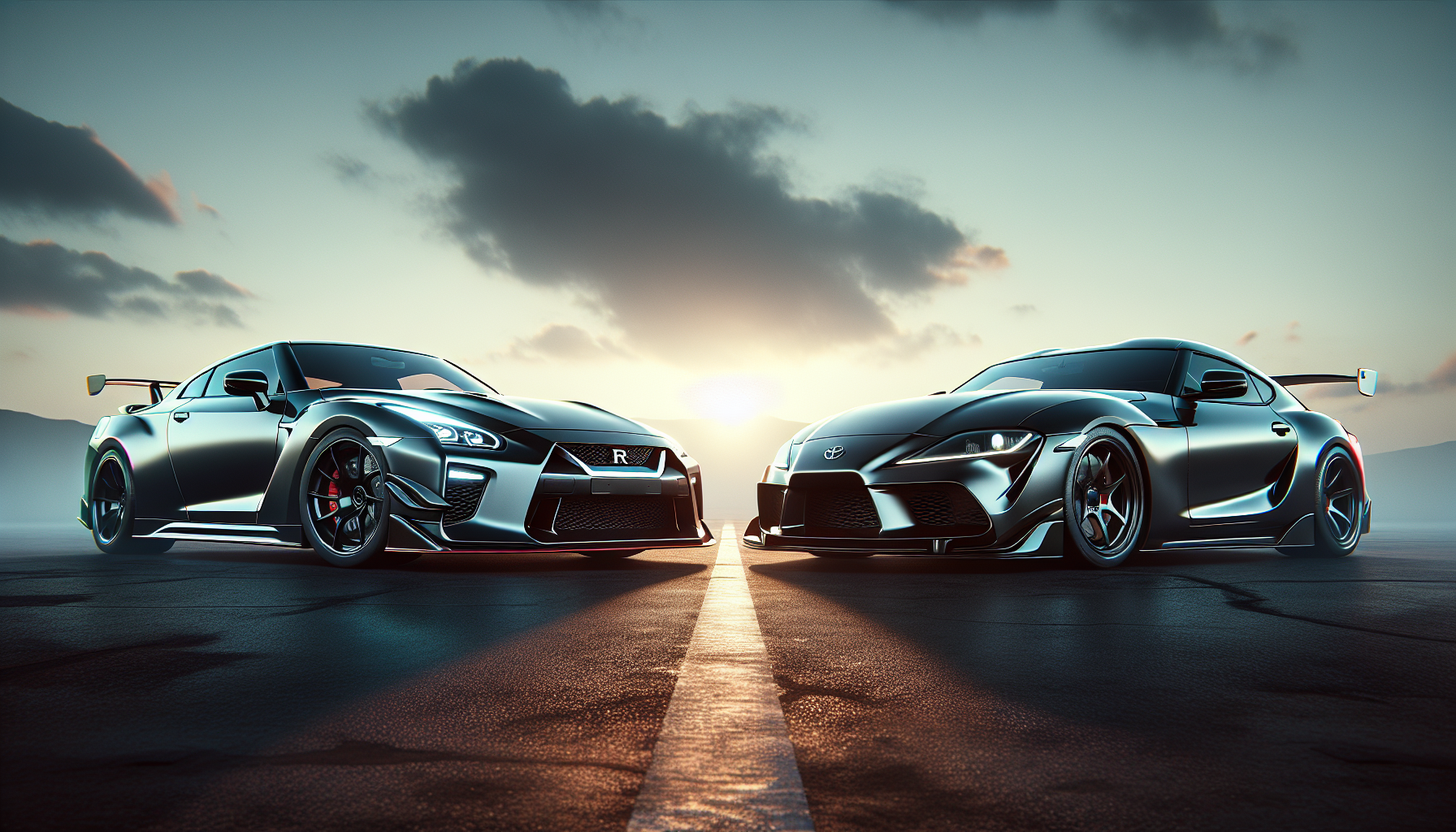
Nissan GT-R R35 vs Toyota Supra A90: Modern Japanese Supercar Battle
There's something unique about Japanese performance cars that western manufacturers have never quite managed to replicate. They're precise, they're obsessive, and they carry decades of motorsport heritage in every bolt. When it comes to the Nissan GT-R R35 vs Toyota Supra A90: Modern Japanese Supercar Battle, you're looking at two machines that represent completely different philosophies — one born from Nissan's relentless pursuit of all-weather, all-conditions dominance, and the other a rear-wheel-drive purist's sports car revived after a 17-year absence. Both carry enormous cultural weight, and both attract ferociously loyal followings.
The R35 GT-R launched in 2007 and immediately rewrote the rulebook on what a car under $80,000 could do. Road & Track described it as "a computer-guided missile before torque vectoring and fancy software became the norm for sports cars," and that assessment still holds. In its early years, virtually nothing at anywhere near its price point could match it on a track. The A90 Supra arrived in 2019 with a different kind of ambition — lighter, more analog in its feedback, and powered by a BMW-sourced turbocharged straight-six that immediately sparked controversy among purists.
Understanding the Nissan GT-R R35 vs Toyota Supra A90: Modern Japanese Supercar Battle properly means looking beyond raw numbers. These are cars with distinct character, different intended buyers, and very different ownership experiences. One is a technological fortress that essentially drives itself to perfection. The other is a driving enthusiast's sports car that asks you to work with it. Neither answer is wrong — they're just answers to different questions.
Nissan GT-R R35: The Technology Monster
The R35 GT-R is, in many ways, the most over-engineered car ever sold at a semi-accessible price point. Nissan's engineers hand-assembled the twin-turbocharged 3.8-liter V6, stamping their names on each engine — a tradition usually reserved for Ferrari or Aston Martin. The result, in base configuration, is a staggering 565 horsepower and 467 lb-ft of torque, channeled through a sophisticated all-wheel-drive system that gives the GT-R its legendary all-conditions composure.
The NISMO variant pushes those numbers considerably further, and the aftermarket support for this platform is virtually limitless. That twin-turbo V6 responds to modification extraordinarily well — shops regularly push GT-Rs past 1,000 horsepower on stock internals with bolt-on upgrades. Motor Junkie notes that the R35 "reimagined the GT-R as a technological powerhouse," and the breadth of its electronic systems backs that up. The dual-clutch gearbox, rear transaxle layout, the ATTESA E-TS all-wheel-drive system, and the predictive suspension all work together in ways that felt genuinely alien when the car launched.
According to CarsGuide, despite its blocky and substantial appearance, the R35 achieves a drag coefficient of just 0.26 Cd, assisted by carefully managed airflow elements, which contributes to its 320 km/h top speed. That's remarkable for a car that looks the way it does — wide, aggressive, and heavy at around 1,740 kg. The weight has always been the GT-R's most-cited weakness, and it's a legitimate one. This is not a car you throw into a tight hairpin and expect effortless rotation. It corners through sheer mechanical grip and computational trickery rather than lightness.
From an ownership perspective, the GT-R demands attention. Service costs are notoriously high — Nissan's dealer network insists on specific maintenance intervals, and parts are expensive. Used examples have softened considerably in price compared to their early days, but running costs remain significant. That said, what you get for the money is genuinely supercar-grade performance wrapped in a practical two-plus-two body.
| Pros | Cons |
|---|---|
| Extraordinary all-weather performance via advanced AWD | Heavy at approximately 1,740 kg |
| 565 hp twin-turbo V6 hand-built by individual technicians | High dealer service costs and strict maintenance requirements |
| Massive tuning potential — reliable 1,000+ hp builds common | The platform is aging — essentially unchanged since 2007 |
| Exceptional high-speed stability (320 km/h top speed) | Rear seats are nominal at best |
| NISMO and T-Spec variants offer significant factory upgrades | Less communicative steering compared to lighter sports cars |
| Proven track record in motorsport and real-world performance | Newer competitor technology has caught up or surpassed it |
| Dual-clutch gearbox delivers rapid, precise shifts | Depreciation hit on early models has stabilized — but it's still a lot to spend |
Toyota Supra A90: The Revived Legend
The A90 Supra arrived under a cloud of skepticism. Toyota had partnered with BMW for the platform and drivetrain, which meant the car came with a B58 turbocharged 3.0-liter straight-six shared with the Z4 M40i. For many Supra faithful — people who'd grown up with the 2JZ-powered A80 — this felt like sacrilege. But once journalists actually drove it, the narrative shifted quickly. The B58 is an excellent engine by any measure, and Toyota's chassis tuning gave the A90 a character genuinely distinct from its BMW sibling.
As EVERYCAR's analysis of the rivalry notes, the Supra line traces back to 1978 and has always been defined by its emphasis on driving dynamics over brute force. The A90 continues that thread. In its current 3.0-liter form producing 382 horsepower in standard trim (Toyota later updated this), the car weighs just under 1,500 kg, which gives it a power-to-weight advantage that pure horsepower figures don't fully convey. It's a rear-wheel-drive car with 50/50 weight distribution, and it shows in the way it handles — balanced, responsive, and genuinely fun to push through corners.
The controversy around the BMW connection hasn't entirely faded, and it manifests in a few ways. The interior carries obvious BMW-sourced switchgear and infotainment systems, which breaks the immersion for some buyers who wanted something that felt Japanese throughout. The iDrive system is excellent, but it's not what you expect when you spend money on a Supra. The aftermarket community has also pointed out that the B58 engine, while responsive to tuning, has a ceiling that the old 2JZ famously didn't — though pushing a B58 past 600 hp with appropriate supporting modifications is entirely achievable.
JohnOnWheels' comparison points out that the Supra's engine is known for its linear power delivery, which contributes to its accessible character. You don't need to be a seasoned performance driver to get the most from this car — it communicates clearly, the throttle response is immediate, and the steering has genuine feedback. The six-speed manual option added in later model years addressed one of the original complaints about the car, giving driver-focused buyers the engagement they were looking for.
Pricing on the A90 Supra positions it as the more accessible of the two, with new examples starting considerably below a comparably-specced GT-R. Maintenance costs are also more manageable — the BMW powertrain has a wide service network, and parts availability is strong. For buyers who want genuine sports car performance without the complexity and cost of the GT-R's all-wheel-drive systems, the Supra makes a compelling case.
| Pros | Cons |
|---|---|
| Lighter weight (~1,495 kg) improves real-world agility | BMW-sourced engine and interior frustrates purists |
| Excellent balanced chassis with 50/50 weight distribution | Less dramatic performance numbers than the GT-R |
| More accessible new and used pricing | Rear-wheel drive limits all-weather usability |
| Broad BMW service network reduces maintenance costs | No manual option at launch — added later as an afterthought |
| Strong B58 tuning support — reliable 500+ hp builds | Interior BMW switchgear breaks the Japanese immersion |
| Communicative, driver-focused steering and handling | Two seats only — even less practical than the GT-R |
| Optional six-speed manual available on later models | Platform shared with a roadster invites ongoing comparisons |
Head-to-Head: Performance, Practicality, and Price
On a drag strip, the GT-R has the clear advantage. HotCars' coverage of GT-R vs Supra drag racing confirms that Japan's turbo legends still dominate when it comes to quarter-mile performance, with the GT-R's all-wheel-drive launch giving it a significant advantage over the Supra's rear-wheel-drive setup. The GT-R gets off the line without the wheelspin drama that can plague powerful rear-wheel-drive cars, and by the time it reaches the trap, it's typically several car lengths ahead.
On a technical circuit with slow corners and elevation changes, however, the gap closes. The Supra's lighter weight and sharper steering response make it more fun and arguably faster through technical sections than the straight-line numbers suggest. The GT-R's electronics do an extraordinary job of managing its mass, but physics still applies — a lighter car with a good chassis will always have inherent advantages through tight, complex sections.
Practicality isn't a strong suit for either car, but the GT-R's rear seats — however cramped — represent a meaningful point of difference for buyers who occasionally need to carry more than one passenger. The Supra is a strict two-seater. Both cars have relatively small trunks and limited cargo capacity, and neither is designed for everyday utility beyond getting two people from one place to another very quickly.
From a long-term ownership cost perspective, the Supra edges ahead. BMW's parts and service infrastructure is widespread, and the B58 engine has proven reliable under normal use. Community discussions on SupraMKV forums reflect that many buyers factor in not just the purchase price but ongoing maintenance when making their choice — and for buyers on a budget, the Supra's lower running costs are genuinely attractive.
The GT-R's aging platform is worth acknowledging. The basic architecture was established in 2007, and while Nissan has updated it over the years with suspension revisions, power increases, and special editions, it hasn't had the fundamental update that competitors have received. The technology that made it revolutionary is now mainstream — almost every performance car on the market uses some version of the systems the GT-R pioneered.
Verdict
In the Nissan GT-R R35 vs Toyota Supra A90: Modern Japanese Supercar Battle, a clear winner depends entirely on what you're buying the car for — but if forced to choose a single recommendation for the broadest range of buyers, the Toyota Supra A90 wins.
Here's the reasoning: the GT-R is a genuinely extraordinary machine, and if you want the most performance per dollar on a drag strip or in any situation where all-weather grip matters, it remains formidable. But it's a car from a platform that launched in 2007, with increasingly expensive maintenance requirements, a weight penalty that limits its fluency on technical roads, and a price premium on well-kept examples that's hard to fully justify given its age.
The Supra, by contrast, offers a more modern platform, lighter weight, accessible ownership costs, strong dealer support, and driving dynamics that are genuinely rewarding in everyday conditions. The BMW connection is a real compromise, and anyone who tells you it doesn't matter hasn't spent time with the original A80 knowing what a fully Japanese Supra felt like. But taken on its own merits — not measured against nostalgia — the A90 is a very good sports car that delivers real performance, driver engagement, and day-to-day usability that the GT-R increasingly struggles to match.
For track-day devotees, drag racers, or anyone who simply wants the maximum performance number, the GT-R still earns its keep. But for the wider audience — those who want a brilliant sports car they can enjoy on canyon roads, weekend trips, and the occasional track day without worrying about servicing bills — the Supra is the smarter, more satisfying choice in 2024 and beyond.
FAQ (Frequently Asked Questions)
How much faster is the GT-R than the Supra in a straight line?
In a quarter-mile drag race, the GT-R typically covers the distance approximately one to two seconds faster than a stock Supra, largely due to its all-wheel-drive launch advantage. HotCars' drag race coverage shows that the GT-R's launch traction consistently gives it a decisive early advantage. On a closed circuit with technical corners, the gap narrows significantly because the Supra's lighter weight and sharper handling balance the equation.
Is the Toyota Supra A90 really just a BMW Z4?
The A90 Supra and BMW Z4 M40i share a platform and the B58 turbocharged straight-six engine, which is the basis of most criticism directed at the A90. However, Toyota developed its own suspension tuning, body structure, and chassis calibration independently — and most automotive journalists who've driven both confirm they feel meaningfully different to drive. The Supra sits lower, has different spring and damper rates, and uses a fixed roof structure that fundamentally changes its rigidity characteristics. It's related to the Z4, not identical to it.
Which car is cheaper to own long-term?
The Supra is generally cheaper to maintain over time. Its BMW-derived powertrain benefits from a broad dealer and independent service network, and parts are widely available. The GT-R, by contrast, has well-documented high service costs — Nissan's own dealer guidelines recommend specific maintenance intervals that can become expensive, and specialized GT-R shops command premium labor rates. Community feedback on SupraMKV forums consistently identifies ongoing costs as a deciding factor for buyers choosing between the two.
Which has better tuning potential?
Both cars respond well to modification, but in different ways. The GT-R's twin-turbo V6 has extraordinary potential — reliable four-figure horsepower builds on stock internals are well-documented, and the aftermarket is enormous after nearly two decades on the market. The B58 in the Supra is also highly tunable, with 500+ hp builds achievable on bolt-on modifications, though its ceiling is somewhat lower than the GT-R's. For the extreme end of tuning, the GT-R wins. For moderate performance upgrades on a budget, the Supra's broad parts availability makes it competitive.
Is the Nissan GT-R R35 still worth buying in 2024?
It depends on your priorities. As Road & Track has noted, the R35 was ahead of its time when it launched, but the wider performance car industry has since adopted and expanded on the technology it pioneered. Used examples represent reasonable value for buyers who want supercar-grade performance at a relatively modest price, and the GT-R's all-wheel-drive system still makes it uniquely capable in wet and cold conditions. The concerns are platform age, rising maintenance costs on older examples, and the fact that newer sports cars have closed the performance gap considerably.