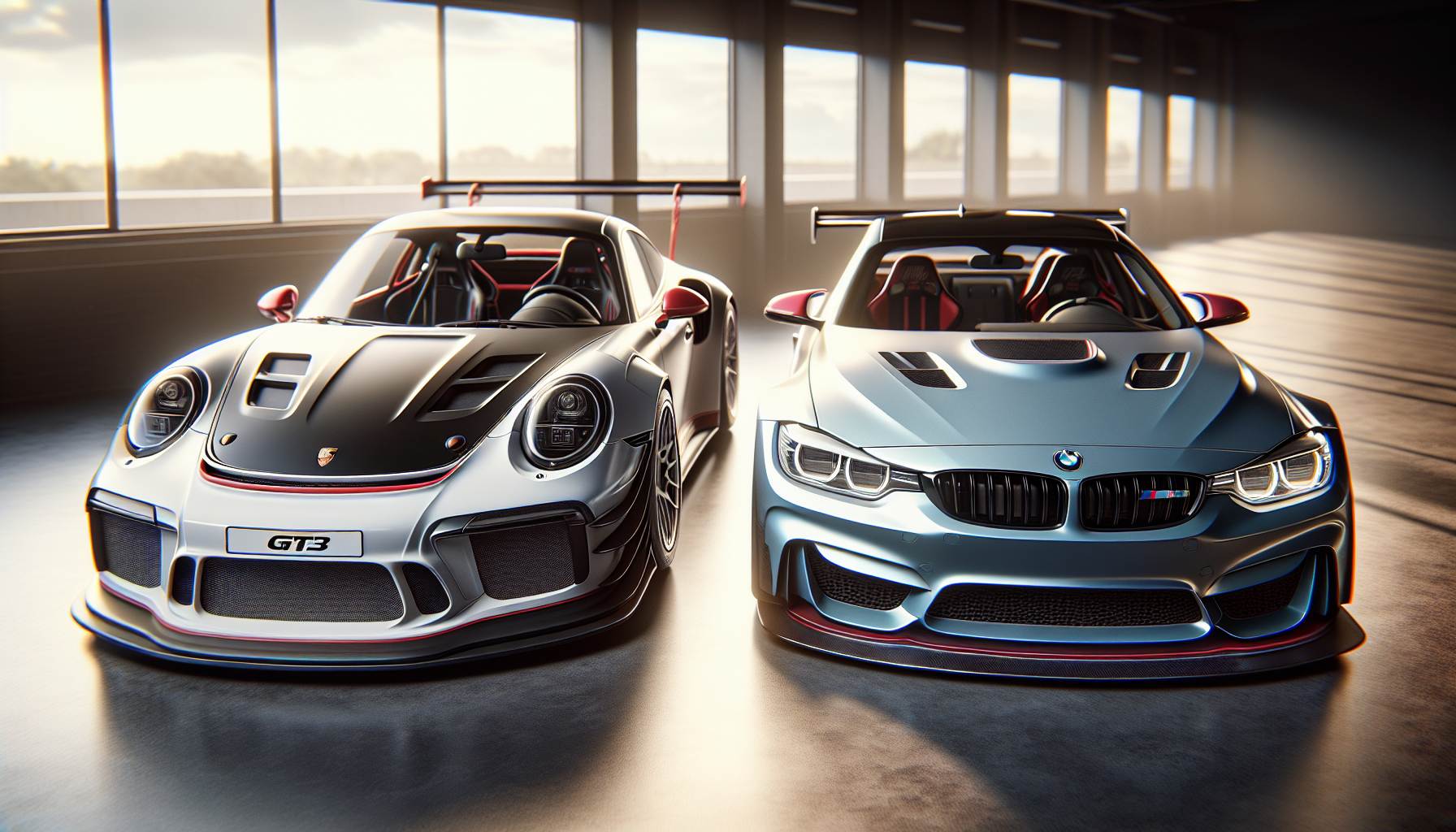
Porsche 911 GT3 vs BMW M4 CSL: Track-Focused German Icons
Germany has a long tradition of building cars that blur the line between road legality and outright racing hardware. Two machines sit at the absolute apex of that tradition right now: the Porsche 911 GT3 and the BMW M4 CSL. Both exist to serve the same essential purpose — to make a talented driver faster on a circuit — yet they go about it in dramatically different ways, reflecting the distinct philosophies of their respective manufacturers.
The 911 GT3 carries decades of motorsport DNA. Every generation has been refined through endurance racing, and the current 992-generation car continues that lineage with a naturally aspirated flat-six that revs to 9,000 rpm, a rear-wing that could double as a park bench, and a chassis tuned so precisely that professional racing drivers use road-spec versions to stay sharp between sessions. The M4 CSL, by contrast, is BMW M's most aggressive road car in a generation — a turbocharged, front-axle-deleted, carbon-saturated machine that sits well above the already capable M4 Competition in the pecking order. Together, the Porsche 911 GT3 vs BMW M4 CSL: Track-Focused German Icons comparison represents two very different answers to the same question: how do you build a German performance car that is genuinely useful on a racetrack?
This article breaks both cars down systematically — powertrain, handling, usability, value, and track performance — and ultimately picks a winner. Neither choice is wrong, but they suit very different types of drivers.
Porsche 911 GT3
The 992 GT3 launched in 2021 with the same 4.0-litre naturally aspirated flat-six carried over in spirit, if not in detail, from its racing siblings. Producing 510 hp and 470 Nm of torque, the engine redlines at 9,000 rpm and sounds unlike almost anything else sold with number plates. Porsche offers the car with either a seven-speed PDK dual-clutch or a six-speed manual — a genuine rarity at this performance level. Lap times at circuits like the Nürburgring Nordschleife sit in deeply serious territory, and the rear-axle steering system, derived from the 911 GT3 R race car, gives the car a nimbleness that defies its relatively conventional layout.
What makes the GT3 special is coherence. Every element — the motorsport-derived double-wishbone front suspension, the aerodynamics package, the recalibrated steering — exists in service of a single goal. The result is a car that communicates constantly and honestly, rewarding drivers who push while remaining forgiving enough not to embarrass those still learning. Porsche has never positioned the GT3 as a numbers machine; the Turbo S handles acceleration statistics. The GT3 is about the process of driving, the feel of a chassis working beneath you, and the howl of an engine that belongs more on Le Mans start grids than public roads.
| Pros | Cons |
|---|---|
| 9,000-rpm naturally aspirated flat-six is sonically and mechanically exceptional | Starting price is high, typically over $200,000 USD before options |
| Available with a six-speed manual — rare at this performance level | Rear-seat and practicality are essentially nonexistent |
| Motorsport-derived suspension delivers world-class chassis feedback | PDK automatic is faster but the manual requires more driver commitment to extract pace |
| Rear-axle steering sharpens both low-speed agility and high-speed stability | Track-focused setup can feel harsh on rough public roads |
| Proven endurance racing heritage translates directly to driver confidence on track | Waiting lists and dealer markups have historically pushed transaction prices well above MSRP |
| Strong residual values and a healthy used market | Naturally aspirated engine means less mid-range torque than turbocharged rivals |
| Clubsport package adds roll cage, fire extinguisher, and harness mounts at no cost | The fixed rear wing divides opinion aesthetically |
BMW M4 CSL
The M4 CSL — Competition, Sport, Lightweight — arrived in 2022 as a limited production run of just 1,000 units globally. It takes the already formidable M4 Competition xDrive platform and strips away weight aggressively: carbon fibre roof, bonnet, front splitter, and diffuser; no rear seats; lighter brake discs; and a redesigned exhaust. The 3.0-litre twin-turbocharged straight-six produces 550 hp and 650 Nm of torque, pushing the car from 0–100 km/h in 3.6 seconds — quicker than the GT3 by a meaningful margin on that specific metric. The M4 CSL holds the distinction of being the most powerful road car BMW M has ever produced at the time of its release.
BMW tuned the CSL's adaptive suspension specifically for track use without making the car undriveable on public roads, though it's a tighter balance than the GT3 manages. The xDrive all-wheel-drive system adds traction but also filters some of the raw communication that rear-wheel-drive purists prize. The carbon bucket seats — fixed-back, not adjustable in the traditional sense — are almost racing-quality, and the stripped interior reinforces that this is a machine built with a specific purpose in mind. The M4 CSL is faster in a straight line than the GT3, likely faster in real-world sprint scenarios, and genuinely capable around a circuit in the hands of a skilled driver.
| Pros | Cons |
|---|---|
| 550 hp turbocharged straight-six delivers massive real-world performance | xDrive AWD system, while excellent, reduces the tactile purity some track drivers seek |
| 0–100 km/h in 3.6 seconds — quicker than the GT3 on paper | No manual transmission option — eight-speed torque-converter automatic only |
| Aggressive weight reduction programme (carbon roof, bonnet, no rear seats) | Limited to 1,000 units globally, making acquisition difficult and prices inflated |
| Fixed-back carbon bucket seats offer genuine motorsport ergonomics | Turbocharged delivery lacks the emotional character of the GT3's naturally aspirated engine |
| More usable torque throughout the rev range than the NA flat-six | The front end's visual redesign remains polarising |
| Significant improvement over the already quick M4 Competition xDrive | Higher starting price than the standard M4 Competition, approaching GT3 territory |
| BMW's M Laptimer and track-specific electronics suite are sophisticated and configurable | Ride quality, even in the softest setting, is firm enough to be tiresome on long journeys |
Verdict — The Porsche 911 GT3 Wins
Comparing the Porsche 911 GT3 vs BMW M4 CSL: Track-Focused German Icons on raw numbers alone would hand the BMW a narrow victory in several categories. It's quicker from a standstill, it produces more torque, and its four-wheel-drive system makes that power more accessible in poor conditions. If your primary concern is cutting the quickest possible lap time with the least driver error, the M4 CSL is a legitimate answer.
But the GT3 wins this comparison because of what it represents as a complete package, and because of what actually matters at a track day or on a spirited mountain road. The naturally aspirated engine is not merely a point of pride — it is a fundamentally different experience from any turbocharged unit. The linear power delivery, the absence of lag, and the sheer acoustic experience of a flat-six singing toward 9,000 rpm create an emotional connection that the M4 CSL's torque surge, impressive as it is, simply does not replicate. Track driving is as much about engagement and feedback as it is about lap times, and on that measure the GT3 is in a category of its own among road-legal cars.
The chassis is also more communicative. The GT3's rear-wheel-drive layout means the driver is working with the car more directly — reading the road, feeling the balance shift under braking and acceleration, making small corrections that build skill and confidence over time. The M4 CSL's xDrive system is excellent, but it is managing some of that communication on the driver's behalf. For a road car used on occasional track days, that's arguably a feature. For a car positioned as a track-focused driver's machine at this price point, it's a compromise.
There is also the question of longevity. The GT3 has an established heritage, a deep community of owners, and a parts and support network that spans decades of motorsport. Used values hold exceptionally well — GT3s frequently sell above MSRP on the used market even years after purchase. The M4 CSL's 1,000-unit production run creates scarcity that inflates resale values now, but the long-term picture is less clear.
The GT3 is available with a manual gearbox in a world that is running out of manual options. That alone matters to a significant portion of the target audience. The option to choose your level of mechanical engagement — PDK for outright pace, stick shift for connection — is something the M4 CSL cannot offer at all.
None of this makes the M4 CSL a bad car. It is extraordinary by any objective measure and may be the better choice for someone who wants brutal, accessible performance on track without the commitment required to exploit rear-wheel drive at its limits. But in the Porsche 911 GT3 vs BMW M4 CSL: Track-Focused German Icons contest, the GT3 wins on the criteria that matter most in this segment: driver engagement, chassis purity, emotional resonance, and the kind of long-term relationship a serious enthusiast wants with a performance car.
FAQ (Frequently Asked Questions)
H3: Which is faster on a racetrack — the Porsche 911 GT3 or the BMW M4 CSL?
It depends on the circuit and the driver. In pure straight-line acceleration, the M4 CSL's 550 hp turbocharged engine and xDrive traction give it an edge, posting 0–100 km/h in around 3.6 seconds. On a circuit with long straights, that power advantage can show. However, the GT3's more communicative chassis, superior feedback, and lighter weight distribution mean that a skilled, experienced driver will often extract better lap times from the 911. The GT3 also has a longer track record in motorsport-adjacent settings, and professional drivers consistently praise its precision at the limit. For most track-day participants, the question is less about which is theoretically faster and more about which allows them to learn and improve — and for that, the GT3's transparency makes it the better teaching tool.
H3: Is the Porsche 911 GT3 available with a manual transmission?
Yes, and this is one of its most significant distinctions in the current market. Porsche offers the 992 GT3 with either a seven-speed PDK dual-clutch automatic or a traditional six-speed manual. The PDK is measurably faster — it shifts in milliseconds and optimises every upshift — but the manual offers a level of mechanical engagement that a growing number of buyers are willing to trade outright pace for. The M4 CSL, by comparison, is only available with an eight-speed torque-converter automatic. For buyers who consider a manual gearbox non-negotiable, the GT3 is the only option in this comparison.
H3: How does the BMW M4 CSL differ from the standard M4 Competition?
The M4 CSL starts from the M4 Competition xDrive platform but departs significantly from it. Power rises from 503 hp to 550 hp through revised software and intake modifications. Weight drops substantially through the removal of the rear seats, a carbon fibre roof, carbon bonnet, and lighter components throughout. The suspension is recalibrated specifically for track use. The fixed-back carbon bucket seats replace the standard M4's adjustable sport seats. Aerodynamics are more aggressive front and rear. Production was capped at 1,000 units globally, making it a genuine limited-run special rather than a production variant. The CSL is not merely a tuned M4 — it is a fundamentally different car in terms of purpose and character.
H3: Which car holds its value better over time?
Historically, the Porsche 911 GT3 has demonstrated exceptional resale value. Limited production numbers, motorsport heritage, and consistent demand from serious enthusiasts mean that GT3s frequently sell used for more than their original MSRP, particularly within the first few years. The M4 CSL's 1,000-unit global production cap creates immediate scarcity that supports strong early resale prices. However, the GT3's decades-long track record of value retention gives it a more predictable long-term profile. Both are likely to remain desirable, but the GT3's broader collector community and established history make it the safer long-term investment of the two.
H3: Which car is more suitable as a daily driver alongside track use?
Neither car is designed primarily for daily driving comfort, but between the two, the GT3 offers slightly more usability — depending on specification. In its standard road setup, the GT3's adaptive suspension handles everyday road imperfections reasonably well, and the PDK variant requires minimal effort in traffic. The M4 CSL's fixed-back carbon seats and stiffer suspension calibration make long motorway journeys less comfortable than the GT3 allows. The M4 CSL also lacks rear seats entirely, whereas the GT3's rear accommodation, though vestigial, does exist. If the car needs to cover significant road miles between track sessions, the GT3 is the more liveable choice.