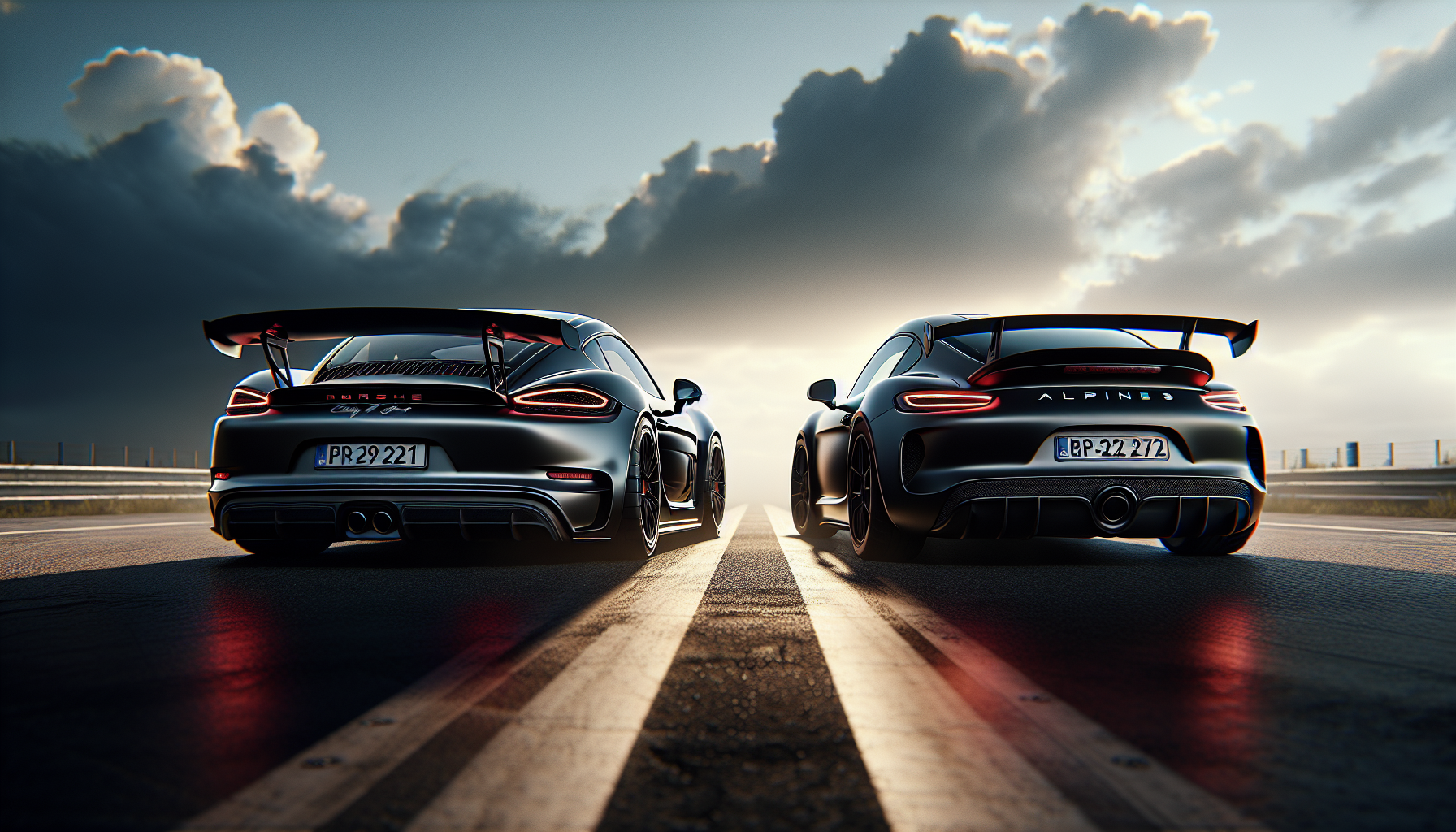
Porsche Cayman GT4 vs Alpine A110 S: Lightweight European Purists
There's a particular kind of driver who doesn't care about 0-60 times in the traditional arms-race sense. They want a car that communicates, that rewards commitment, that makes a B-road feel like a private racetrack. For that driver, the Porsche Cayman GT4 vs Alpine A110 S: Lightweight European Purists debate isn't just about spec sheets — it's about philosophy. Both cars represent the absolute best their manufacturers can offer outside of full-blown racing machinery, and both arrive at greatness through the same fundamental conviction: less weight, more feel.
The Porsche Cayman GT4 carries serious pedigree. It uses a naturally aspirated flat-six derived from the 911 GT3, it sits on motorsport-inspired suspension geometry, and it's built by a company with more racing victories than most people have had hot dinners. The Alpine A110 S, on the other hand, is something rarer — a small French sports car from a brand that was effectively reborn in 2017, committed to the idea that a car weighing under 1,100 kilograms with a turbocharged four-cylinder could embarrass much more powerful machines simply by being smarter about physics. One car is the establishment; the other is the insurgent. Both are extraordinary.
What makes this comparison genuinely fascinating is that the two cars aren't really chasing the same experience. The Cayman GT4 is more powerful, louder, more aggressive, and more obviously track-focused. The A110 S is lighter, more delicate, almost balletic by comparison. Choosing between them says something about who you are as a driver. This article breaks down each car honestly — strengths, weaknesses, and the verdict that enthusiasts actually want to hear.
Porsche Cayman GT4
The 718 Cayman GT4 arrived in its current generation as something of an apology and a triumph simultaneously. Porsche had spent years fitting the standard Cayman with turbocharged four-cylinder engines — practical, efficient, fast — and the enthusiast community never fully forgave them for it. The GT4 was the correction: a 4.0-litre naturally aspirated flat-six borrowed from the 991-generation 911 GT3, producing 414 horsepower, mated exclusively to a six-speed manual gearbox (PDK was not available at launch). The result is one of the most complete driver's cars Porsche has ever built below the 911 range.
What sets the GT4 apart mechanically is the front suspension geometry lifted directly from the 911 GT3, combined with rear suspension elements also borrowed from the GT lineage. The car sits 30mm lower than the standard Cayman, uses adaptive dampers (PASM) as standard on later versions, and generates genuine aerodynamic downforce through its fixed rear wing and front splitter — not cosmetic additions, but functional components that were tested at the Nürburgring extensively. Porsche claims a lap time of 7:28 at the 'Ring in the GT4 RS variant, though the base GT4 itself is no slouch.
The flat-six engine is arguably the star of the show. It revs to 8,000 rpm, produces its peak torque of 309 lb-ft at 5,000-6,800 rpm, and makes a sound that reminds you why naturally aspirated engines remain the emotional gold standard. There's no turbo lag, no plateau of mid-range shove — just a linear, ever-building crescendo that rewards high-revving commitment. Combined with the mid-engine layout, which gives the GT4 near-perfect 43/57 front-to-rear weight distribution, the car handles with a precision that makes other sports cars feel approximate.
Kerb weight sits at approximately 1,415 kg — not featherlight, but managed through chassis tuning to feel more nimble than the number suggests. On track or on a challenging road, the GT4 is extraordinarily balanced. Understeer is minimal; the car rotates willingly with throttle input and punishes clumsy driving while rewarding those who learn its language. The braking hardware — 380mm front discs with six-pot calipers — is comparable to dedicated track machinery.
Porsche Cayman GT4: Pros and Cons
| Category | Pros | Cons |
|---|---|---|
| Engine | 4.0L naturally aspirated flat-six; 414 hp; 8,000 rpm redline; extraordinary sound | Relatively heavy compared to A110 S |
| Handling | GT3-derived suspension; near-perfect weight distribution; exceptional at-limit precision | Ride quality on standard roads can be firm |
| Driver Engagement | Six-speed manual only (launch spec); tactile steering; communicative chassis | Manual-only means some buyers look elsewhere |
| Track Capability | Fixed rear wing provides real downforce; 380mm brakes; Nürburgring-proven | More track-biased setup means compromise on daily comfort |
| Sound & Character | One of the best-sounding modern sports cars; nat-asp character | NA engine means lower peak efficiency vs turbo rivals |
| Practicality | Two storage trunks (front and rear); standard Porsche build quality | Higher price point than A110 S; options list inflates cost quickly |
| Resale Value | Strong residuals; Porsche GT cars hold value exceptionally well | High initial transaction price |
Alpine A110 S
The Alpine A110 S occupies a peculiar and wonderful place in the sports car landscape. It's a car that weighs somewhere between 1,082 and 1,110 kg depending on specification — lighter than the original Lotus Elise — yet it comes with real-world amenities, a reasonable ride quality, and a turbocharged 1.8-litre four-cylinder that makes 300 horsepower. That power-to-weight ratio, around 270 hp per tonne in the S variant, is genuinely exceptional. The 'S' designation differentiates it from the standard A110 through stiffer suspension (Sachs dampers), sharper steering calibration, larger Brembo brakes, and a slightly higher power output than the base car's 252 hp.
The A110 S traces its lineage to the original Berlinette A110, which won the inaugural World Rally Championship in 1973. The modern car captures something of that spirit — it's mid-engined, aluminium-intensive in both body and chassis, and built with the conviction that lightness solves most problems that horsepower cannot. The aluminium spaceframe chassis is a genuine engineering achievement for a low-volume manufacturer; it's stiff, light, and forms the foundation for handling behaviour that has genuinely shocked people who expected a novelty.
On the road, the A110 S is one of those rare experiences where the car and driver become a unit almost immediately. The steering is precise and well-weighted, the chassis communicates beautifully through the seat and wheel, and the mid-engine layout — with the engine longitudinally mounted ahead of the rear axle — provides balance that many more expensive cars can't match. Unlike the Cayman GT4, which demands respect and some measure of commitment to unlock its best qualities, the A110 S is immediately accessible. It's not a soft car by any means; the S variant's suspension is notably sharper than the standard A110's. But it's never intimidating.
The turbocharged engine is the one area where ideology and reality diverge slightly. The 1.8T is a Renault-derived unit and does its job efficiently, but it lacks the emotional texture of the Cayman's flat-six. There's a degree of turbo lag at very low revs, and while the seven-speed dual-clutch gearbox (no manual option is offered) is rapid and well-calibrated, purists will note the absence of a third pedal. The gearbox in Sport mode is crisp, but it does filter some of the mechanical directness that a manual transmission delivers.
Alpine has been meticulous about keeping the car's weight in check. The standard A110 S uses a fixed rear spoiler (smaller and less dramatic than the GT4's wing) and front diffuser elements that are tasteful rather than aggressive. This is intentional — the car was tuned for road dynamics first, with track ability as a consequence rather than a primary goal. On a flowing B-road with mixed surfaces, the A110 S feels more at home than on a flat, smooth race circuit. This is its natural habitat, and in that environment, it's as good as anything at any price.
Alpine A110 S: Pros and Cons
| Category | Pros | Cons |
|---|---|---|
| Weight | ~1,082–1,110 kg; exceptional power-to-weight ratio; feels nimble at all speeds | Lightness means less crash protection perception vs heavier rivals |
| Handling | Immediately accessible; beautifully balanced; communicative in all conditions | Less downforce than GT4; less planted at very high track speeds |
| Engine | 300 hp 1.8T; rapid throttle response for a turbo; adequate power for the weight | No nat-asp character; turbo lag at low revs; not particularly sonorous |
| Gearbox | 7-speed DCT is fast and well-tuned | No manual option available; reduces tactile engagement |
| Daily Usability | Better ride quality on standard roads than GT4; easier to drive quickly every day | Less track-focused hardware than GT4 |
| Price | Significantly more affordable than GT4; options list less punishing | Lower brand recognition and smaller dealer/service network than Porsche |
| Character | Unique, charming, and underrated; a true driver's car in the original sense | May feel underwhelming to those expecting more drama |
Head-to-Head: Where They Differ Most
The Porsche Cayman GT4 vs Alpine A110 S: Lightweight European Purists comparison ultimately comes down to what kind of driving experience you're optimising for. These aren't just different specifications — they're different answers to the same question.
Power and Sound: The GT4 wins this completely. Four hundred and fourteen naturally aspirated horsepower revving to 8,000 rpm is an experience that no turbocharged four-cylinder can replicate emotionally, regardless of what the stopwatch says. The flat-six's howl in the upper rev range is one of the finest noises a road car makes in 2024.
Agility and Accessibility: The A110 S wins here, and it wins convincingly. At 270 kg lighter than the GT4, the Alpine changes direction with an effortlessness that the Porsche cannot match. More importantly, the A110 S delivers its best qualities at legal road speeds. The GT4 needs space and speed to truly come alive; the Alpine rewards you immediately.
Track Performance: The Cayman GT4 is the serious track tool. Its aerodynamics, brake package, and suspension geometry are designed for circuit work. The A110 S can do track days but starts to feel out of its depth when pushed repeatedly on circuit — brake fade is more of a concern, and the limited downforce means it's less stable at sustained high speeds than the GT4.
Value: The A110 S costs considerably less than the GT4 in most markets. The Porsche's options list is famously aggressive, and a fully specced GT4 can exceed £100,000 in the UK. The Alpine represents genuinely extraordinary value for the experience it delivers.
Daily Usability: Both cars have front trunks, reasonable interior quality, and are usable as daily drivers by sports car standards. The A110 S's softer default damper setup (even in S trim compared to the GT4's firmness) makes it marginally more comfortable over broken road surfaces.
Verdict
In the Porsche Cayman GT4 vs Alpine A110 S: Lightweight European Purists contest, a winner must be declared — and that winner depends entirely on context. But if forced to pick one for most drivers, most of the time, across the full spectrum of what a sports car needs to be in everyday life, the Alpine A110 S is the more remarkable achievement.
That's not a slight against the Cayman GT4, which is genuinely one of the best driver's cars Porsche has ever built and deserves every superlative it has received. But the GT4 is extraordinary in a way that requires a specific context to appreciate fully — it needs a track, or a very long, clear road, or the kind of commitment that comes from having given a car your complete attention. The A110 S is extraordinary in a more democratic and immediate way. It delivers its best qualities at speeds you can actually explore without a race licence. It weighs almost nothing, handles with a purity that most manufacturers have abandoned in the pursuit of numbers, and costs significantly less to buy and run.
For the driver who lives near a circuit, runs track days regularly, and wants the most capable road-legal machine that still wears number plates, buy the GT4. It will make you better on track, it will reward sustained commitment more thoroughly, and that engine note alone is worth significant money.
For the driver who wants the best sports car for the real world — backroads, occasional track days, and the occasional moment of genuine joy on an empty A-road — the A110 S is the answer. It's lighter, sharper in context, more accessible, and cheaper. In the original sense of what a lightweight, pure-bred European sports car should be, the Alpine A110 S might actually be more true to the ideal than the Porsche. That's extraordinary company to keep.
FAQ (Frequently Asked Questions)
H3: Is the Porsche Cayman GT4 available with a PDK automatic gearbox?
The original 718 Cayman GT4, launched in 2019, was offered exclusively with a six-speed manual gearbox — a deliberate decision by Porsche's GT department to maintain driver involvement. Later, Porsche introduced the Cayman GT4 RS, which came only with PDK due to its higher-revving engine requiring faster shifts. If you want a manual GT4, the base GT4 is your car; if you want PDK, the GT4 RS is the only option within the GT4 family.
H3: Does the Alpine A110 S have a manual gearbox option?
No. The Alpine A110 S uses a seven-speed dual-clutch automatic gearbox exclusively. Alpine has never offered a manual in the modern A110 range. While this is a genuine drawback for purists, the DCT is well-calibrated and shifts quickly in Sport mode. Alpine's decision reflects both packaging constraints and the reality that a manual with the longitudinally mid-mounted engine would require significant engineering complexity.
H3: Which car is faster on a circuit — the GT4 or the A110 S?
On a typical circuit, the Cayman GT4 will be faster. It produces more power (414 hp vs 300 hp), generates meaningful aerodynamic downforce from its fixed rear wing, has a superior brake package, and was developed with circuit performance as a primary objective. The A110 S is quick for its power output due to its low weight, but the GT4's additional downforce and outright power advantage means it will lap quicker on most tracks. The gap closes on very tight, technical circuits where the Alpine's low-speed agility and lighter weight matter more.
H3: How does the weight difference between the two cars affect real-world driving?
The approximately 270 kg weight difference is enormous in real-world terms. The Alpine A110 S feels responsive and nimble at relatively modest speeds — direction changes require less physical effort, braking distances are shorter for the same brake hardware, and the car's balance can be exploited on tighter roads where the Cayman would feel more committed and deliberate. The GT4's weight is managed through precise engineering, but in the Porsche Cayman GT4 vs Alpine A110 S: Lightweight European Purists context, the Alpine's lighter mass is a consistent advantage across varied driving conditions.
H3: Which car is better value for money?
The Alpine A110 S offers better value for money in most objective assessments. It costs significantly less than a comparably equipped Cayman GT4 — often £20,000-£30,000 less in the UK market when the GT4's options are factored in. Given that the A110 S delivers a driving experience that legitimately rivals or exceeds the GT4 in several key areas (road agility, accessibility, ride quality), the value proposition is strong. Resale values for Porsche GT cars are historically more robust, however, which partially offsets the purchase price premium over time.